
Strategic Execution Intelligence, in operator language.
Execution Physics, the Mirror, the Capability Framework, the Flywheel, the QxC. The discipline underneath every engagement, made interrogable.
Most strategic execution work runs on opinion. The same variance, presented to three different consultants, produces three different explanations of what caused it. Our methodology is built to do better than that — to bring the diagnostic discipline that medicine, finance, and operations have already developed in their domains to the layer where strategy meets execution. Strategic Execution Intelligence is the discipline. Execution Physics is the thesis underneath. The four primitives are how the discipline becomes operational. The Quarterly Execution Cycle is the cadence the discipline runs on.
Four primitives, in strict dependency order.
None of them are features. Each is a separate conceptual building block. Remove any one and execution reverts to opinion, assumption, repetition, reset.
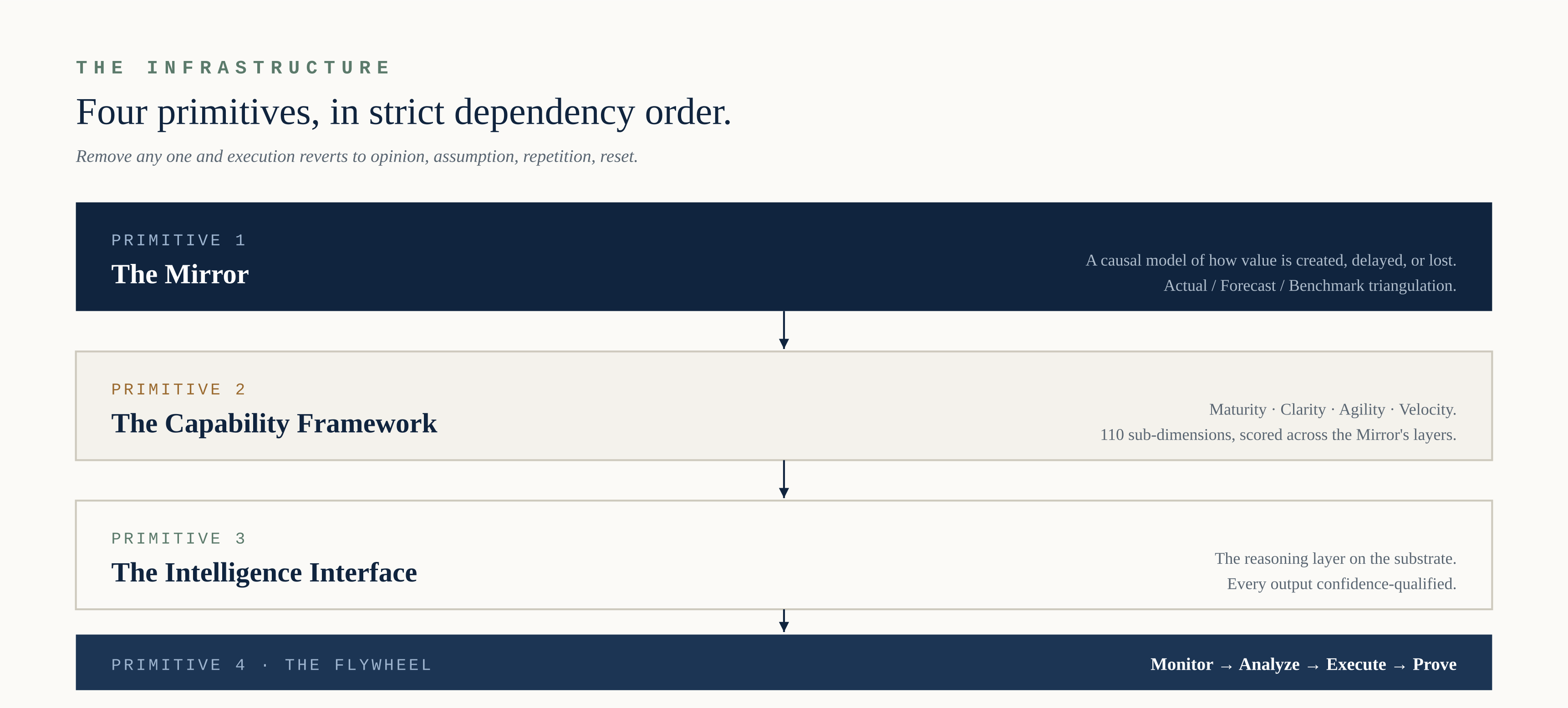
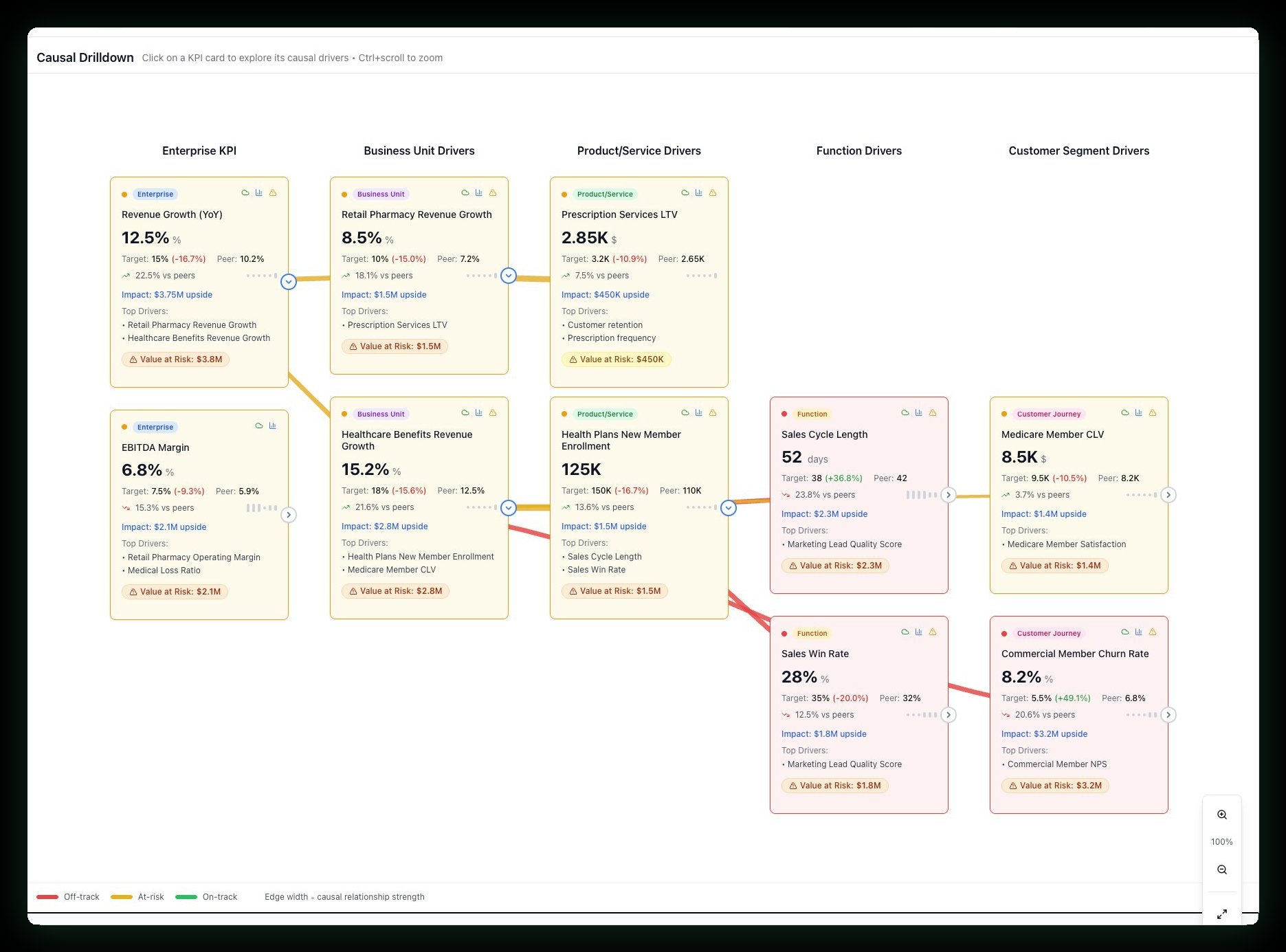
The Mirror
A causal model of how value is created, delayed, or lost in your business. Outcomes trace down through business unit, product, function, and customer layers — and across to the capability constraints that determine throughput. Every metric is triangulated against three reference points: Actual, Forecast, Benchmark. The triangulation produces two gap types: the Stability Gap (Actual ↔ Forecast) and the Innovation Gap (Actual ↔ Benchmark). Not a dashboard. Not a driver tree. A structural model of execution.
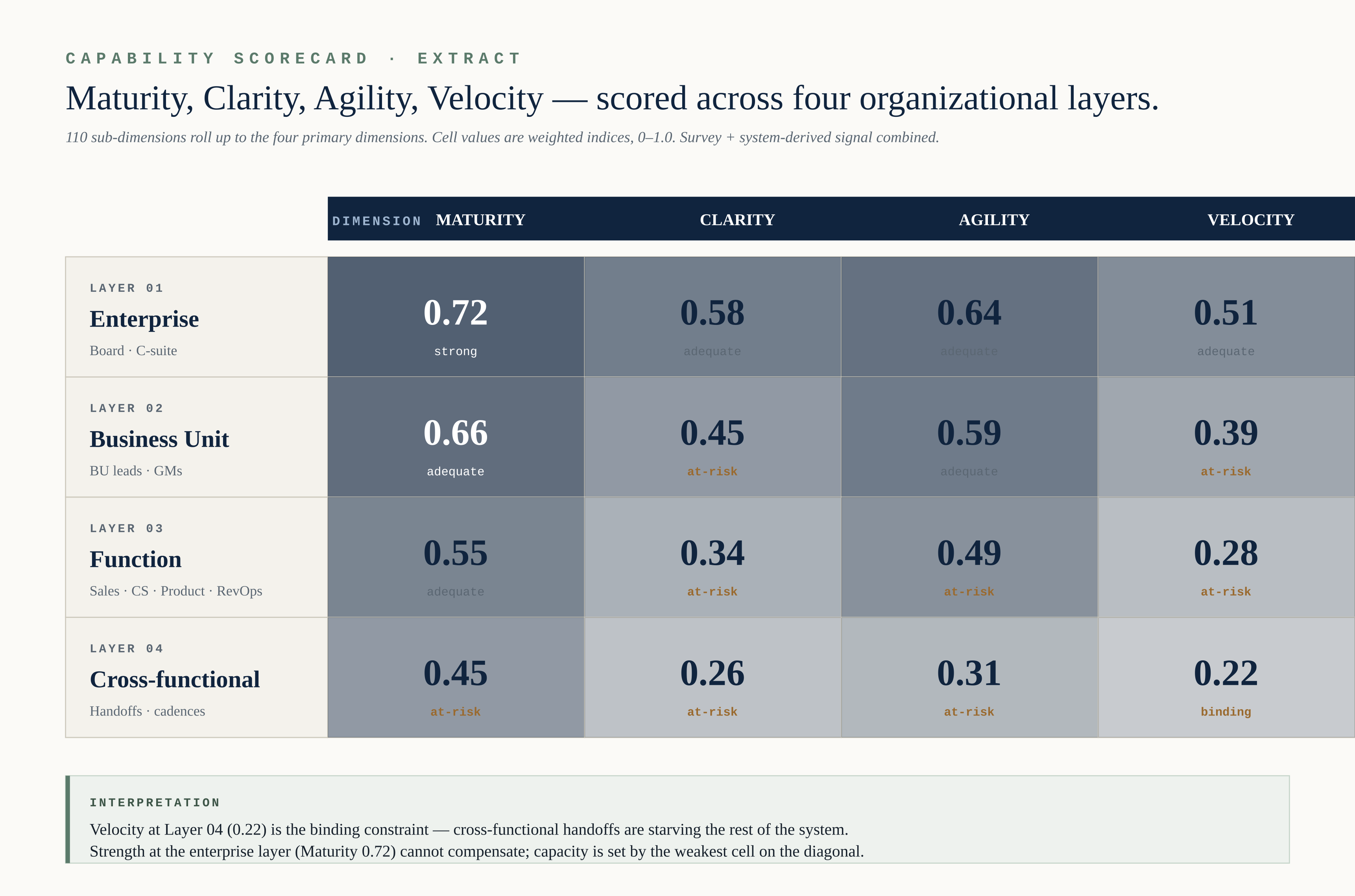
The Capability Framework
Maturity, Clarity, Agility, Velocity — one hundred and ten sub-dimensions, measured through structured survey and system-derived signal in combination. Scored across the organizational layers of the Mirror. The framework turns "execution feels hard" into "this specific capability constraint is binding right now, at this layer, with this confidence level, with this contribution to the outcome you're trying to move." Extended with the dual-approach methodology that protects it against the standard critique of capability surveys.
The Intelligence Interface
The reasoning layer that sits on top of the Mirror and the Capability Framework, anchored to your sector's substrate, calibrated to your company's data, with memory and personality designed for senior decision contexts. Asks questions, surfaces patterns, traces answers back to their source. Every output carries confidence qualification. Not a query box on top of generic AI.
The Flywheel
Monitor → Analyze → Execute → Prove. The closed-loop discipline that turns one-time analysis into compounding intelligence. Each cycle senses new signals, refreshes the causal interpretation, runs the next intervention, and proves what moved. The flywheel is what turns SEI from a project artifact into a discipline that compounds.
Execution Physics: how execution behaves under measurement.
Execution Physics is the formal thesis underneath Strategic Execution Intelligence. It says: execution is not a cultural feeling, not a leadership style, not a soft variable. It is an economic constraint that behaves predictably when properly measured. The four capability dimensions have causal relationships among themselves; they multiplicatively determine execution capacity; they can be scored, weighted, and traced to specific financial outcomes through the Mirror's cross-causal architecture.
Built on established theory — queueing dynamics from operations research, constraint theory from manufacturing, causal inference from modern statistics, governance discipline from program management — applied to a layer of enterprise work that has historically run on tribal knowledge. Twenty-five-plus implementations have refined and validated the thesis under real operating conditions. The white paper is available on request. The reasoning is interrogable end-to-end.
The Quarterly Execution Cycle.
A disciplined operating model for delivering measurable business value with strategy, technology, AI, and execution intelligence — every 90 days.
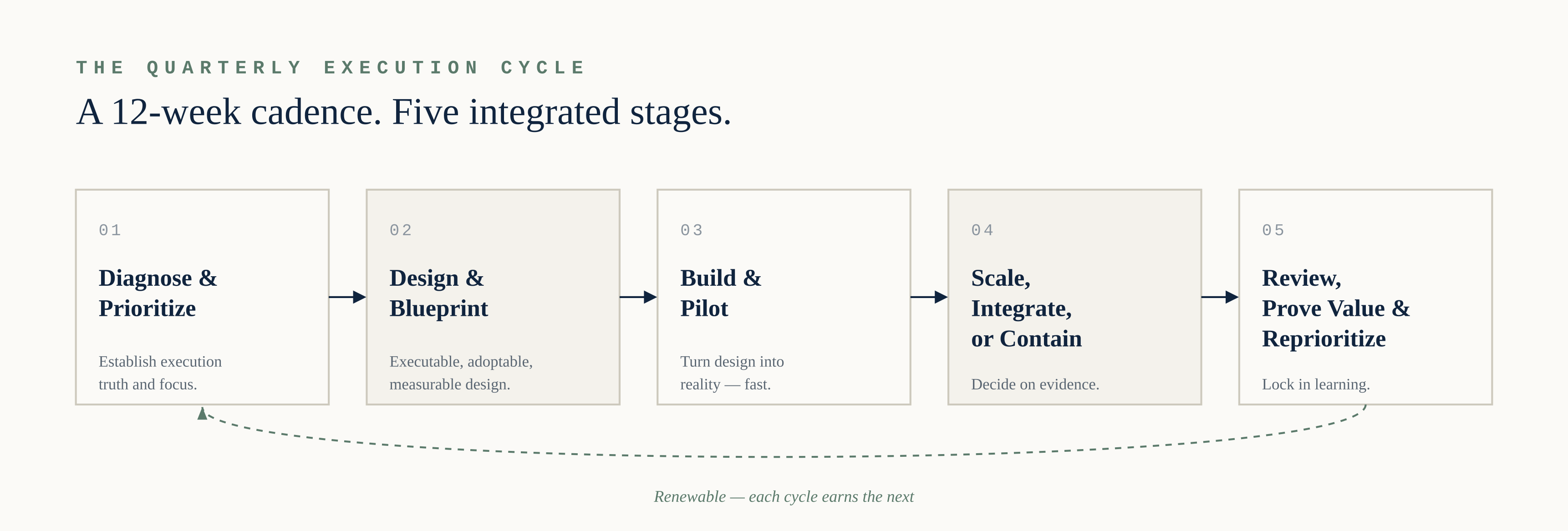
Diagnose & Prioritize
Establish execution truth and focus. Assess workflows, decision loops, execution friction; map current-state processes and value drivers; identify the highest-value initiatives for the quarter.Output: prioritized Quarterly Execution Portfolio, success metrics, value hypotheses.
Design & Blueprint
Design solutions that are executable, adoptable, and measurable. Redesign workflows end-to-end; define system boundaries, architecture, and data needs; specify AI and intelligence components where they matter.Output: future-state workflow designs, solution blueprint, KPI measurement plan.
Build & Pilot
Turn design into reality — fast. Build execution systems, MVPs, or automation solutions; integrate technology, data, AI, and operating rhythms; pilot with real users in live environments.Output: live solution, pilot results with quantified impact, refined design.
Scale, Integrate, or Contain
Decide what happens next — based on evidence. Scale what works across teams, functions, or the enterprise; integrate into existing systems; or keep purpose-built and bounded where appropriate.Output: scaled solution or stable custom system, updated operating processes and roles.
Review, Prove Value & Reprioritize
Lock in learning and guide the next cycle. Compare outcomes against baselines and hypotheses; capture insights on execution, adoption, and value creation; reprioritize the next portfolio.Output: Quarterly Value Realization Report, decision on next-cycle focus, updated roadmap.
The QxC Promise
Every 90 days, clients receive: clear execution truth, working solutions in production or pilot, measured business impact, a prioritized roadmap for the next cycle. No multi-year black boxes. No slideware without execution. No technology without proof.