Decision Intelligence, as a discipline — installed, not delivered.
The strategic execution layer of your enterprise — finally instrumented, governable, and continuously sharpening. We install the analytical substrate, the causal models, and the practitioners that turn Decision Intelligence from a Gartner category into your operating reality.
A new category has arrived.
Your enterprise will run on it.
In January 2026, Gartner published the inaugural Magic Quadrant for Decision Intelligence Platforms and named DI a late-stage emerging market — a strategic enabler for organizations of any size, geography, and industry. By Gartner's own data, more than half of large enterprises have already deployed Decision Intelligence or are committed to deploy within six months.
Decision Intelligence is the structural shift in how enterprise work gets done. It is not a tool, not a dashboard, not an AI integration. It is the analytical infrastructure that makes the strategic execution layer of an enterprise — the layer where capability constraints meet financial outcomes — finally legible, measurable, and governable in real time.
The question isn't whether your enterprise will operate inside this category. The data already answers that. The question is whether your firm has the discipline, the substrate, and the practitioners to operate inside it well.
Source: Gartner Magic Quadrant for Decision Intelligence Platforms, January 2026; Gartner Hype Cycle for Emerging Technologies, 2025. Gartner does not endorse any vendor, product, or service depicted in its research.
Every firm is doing two things at once.
Most do neither well.
Strategy, properly understood, is the simultaneous pursuit of two distinct disciplines. Most firms treat them as competing priorities or vague aspirations. They are not. They are specific, measurable, and governable — but only when the analytical substrate underneath them is built to surface both at once.
Stability
The demonstrated capacity to commit and deliver — to set financial and operating outcomes and consistently achieve them. Not safety, not status quo. Stability is what proves leadership has accurate self-knowledge of the enterprise. When stability is low, forecasts can't be trusted, plans don't land, and credibility erodes — with the board, the capital markets, and the talent the firm needs to retain.
The diagnostic question Stability answers: Can this firm do what it said it would do?Innovation
The demonstrated capacity to close the gap to what peers achieve and what's structurally possible — to identify the execution capability constraints that limit potential and address them at root cause. Not novelty for its own sake. Innovation is what proves the firm is becoming the version of itself the market requires. When innovation is low, the firm executes its own plan reliably but the plan falls below the market's evolving frontier.
The diagnostic question Innovation answers: Is this firm becoming what it needs to be?A firm strong on both is operationally trustworthy and structurally advancing. A firm strong only on stability is reliable but stagnant. A firm strong only on innovation is aspirational but unreliable. Most firms have neither under quantified, real-time governance — which is exactly the gap Decision Intelligence is built to close.
We practice Strategic Execution Intelligence.
Strategic Execution Intelligence (SEI) is our founding sub-category of Decision Intelligence — the application of DI to the strategic execution layer of an enterprise, where capability constraints causally drive financial outcomes and where most enterprise value is actually won or lost. The discipline rests on a thesis we call Execution Physics — the framework for how execution actually behaves under measurement.
Our practitioners install that substrate inside your enterprise. They calibrate it to your sector, your data, your organizational layers, and the specific situations your leadership team needs to navigate. They run it alongside your team in 90-day cycles. And they leave behind compounding capability — measurement, instrumentation, and operating cadence — that grows sharper over time.
Built for this category. Not retrofitted to it.
Three structural differences from how Decision Intelligence is being delivered everywhere else.
Decision Intelligence requires causal linkage across the organization — from customer-layer signals up through functions, products, and business units to enterprise outcomes, with contribution weighting at every layer. We install that architecture. We don't sell function-by-function integrations that recreate the silos DI is built to dissolve.
Founded by leaders trained at BCG and seasoned through enterprise operating roles at Bank of America and Liberty Mutual, Zero Fog brings the analytical depth of top-tier strategy work — delivered at materially faster cadence and lower cost, because the substrate compresses what legacy consulting staffs with rotating teams.
Every engagement leaves behind a calibrated substrate, instrumented capability measurement, and an operating cadence your team can increasingly run themselves. Stability and Innovation become continuously governable from inside your firm, with Zero Fog as accelerator rather than dependency.
The Quarterly Execution Cycle.
Proof every 90 days. No multi-year black boxes. No slideware without execution.
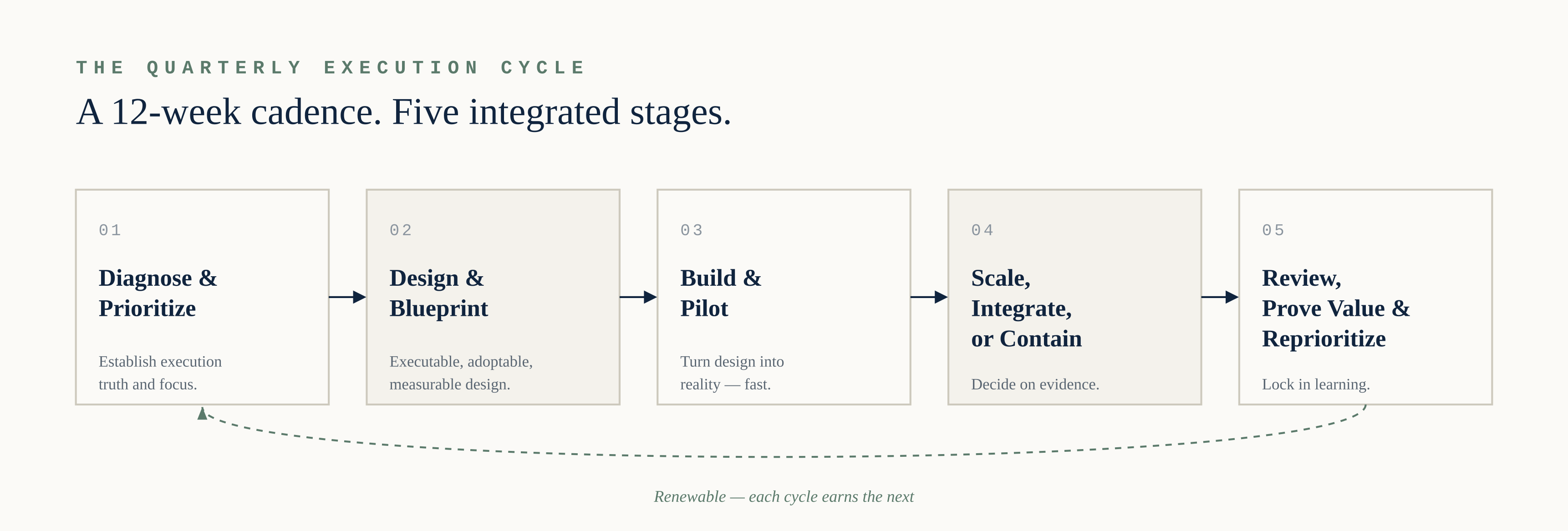
Every Zero Fog engagement runs on a disciplined 12-week cadence with five integrated stages. Each cycle delivers working execution outcomes, measured business impact, and a prioritized roadmap for the next 90 days. Value is proven before scale is assumed.
Powered by Rejoyce.
Our practice deploys the Rejoyce Decision Intelligence substrate as the analytical infrastructure underneath every engagement. Rejoyce is the productized SEI platform — the causal Mirror, the capability framework, the intelligence interface, and the closed-loop learning system, operating as one integrated substrate at the strategic execution layer.
For most clients, Rejoyce is the engine our practitioners use to deliver the work. For clients who want to retain and expand the substrate after the engagement, Rejoyce is also available as a standalone platform.
A consulting firm built on Decision Intelligence — not retrofitted to it.
Zero Fog is the founding practice of Strategic Execution Intelligence — a defined sub-category of Decision Intelligence that we and Rejoyce have built together as the analytical and applied infrastructure for the strategic execution layer of the enterprise.
Founded by leaders trained at BCG and seasoned through enterprise operating roles at Bank of America and Liberty Mutual, the firm carries fifteen years of operating-side experience into every engagement. The methodology was developed across those engagements, codified into the Execution Physics thesis, and productized into the Rejoyce substrate that now powers our work.
Begin with a diagnostic.
Every engagement starts with a focused diagnostic — an Execution Readiness Assessment that surfaces where your enterprise value is most exposed, where your Stability and Innovation gaps actually sit, and which capability constraints would govern the first Quarterly Execution Cycle.